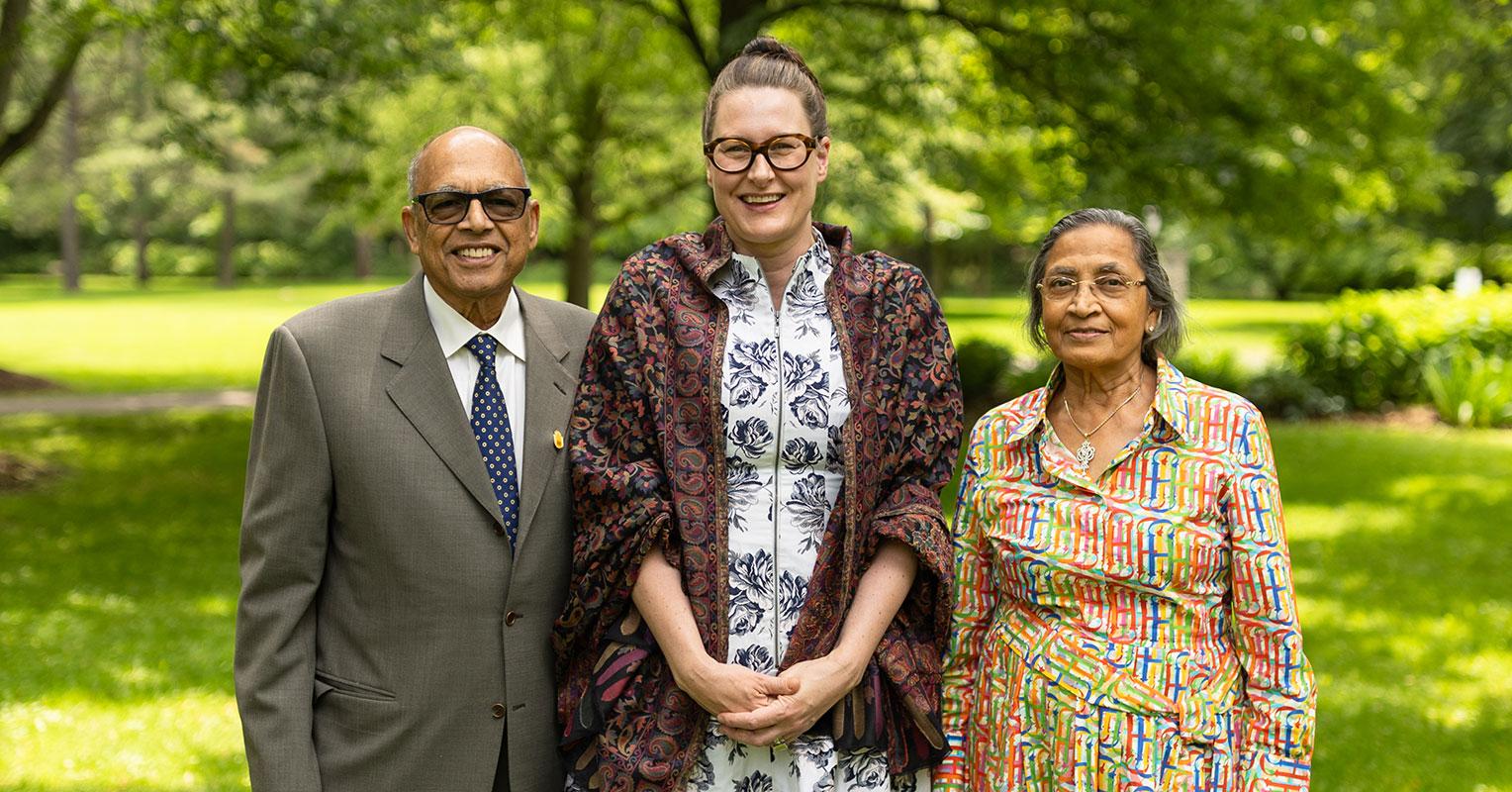
“A moment like this doesn’t come along often,” says Janice Stein, founding director of the Munk School of Global Affairs & Public Policy. “When universities elsewhere are under assault, to be able to attract faculty members who are among the very best in their fields, with the creativity and curiosity to challenge conventional wisdom – this is an immense opportunity for the Munk School, for U of T and for Canada.”
The catalyst for Prof. Stein’s bullish remarks was the announcement in March 2025 that three highly regarded scholars were leaving Yale University and heading north to the Munk School:
Timothy Snyder, a historian of Central Europe, Ukraine, the Soviet Union and the Holocaust, has been named the inaugural Chair in Modern European History. The author or editor of 20 books, including the international bestsellers On Tyranny and On Freedom, Prof. Snyder is teaching graduate and undergraduate students, as well as leading the Public History Lab, which focuses on “deepening our understanding of freedom, democracy and human value.”
Joining him is Marci Shore, an expert on modern authoritarian movements in Central and Eastern Europe, who is the Munk School’s first Chair in European Intellectual History. An award-winning scholar, Prof. Shore also regularly contributes to publications such as The New Yorker, The Atlantic and The New York Times. Her chair position, like that of Prof. Snyder, is supported by the Temerty Endowment for Ukrainian Studies, an endowed gift from the Temerty Foundation.
Also arriving from Yale is Jason Stanley, a philosopher whose work spans linguistics, epistemology and cognitive science, as well as social and political philosophy. Author of the acclaimed book How Propaganda Works, Prof. Stanley assumes the Bissell-Heyd Chair in American Studies, funded by the U.S.-based Associates of the University of Toronto.
“These new faculty members will have an enormous impact,” says Prof. Stein. “Our students will be able to engage with important thinkers who are addressing the biggest issues of our time. They’ll learn not only from lectures, but through talking to these scholars outside class and seeing how their thinking is grounded in lived experience.”
The new chairs have become part of a vibrant, multidisciplinary research ecosystem. “Our school is enriched by three talented individuals and also by the networks they bring with them,” Prof. Stein says. “Timothy Snyder, for example, is leading a large project on the history of Ukraine. The opportunity this offers other Munk scholars to connect with colleagues worldwide is invaluable.”
Visionary donors
The Munk School will also welcome a new director in September 2026: Mark Duggan, an influential economist and policy scholar who is currently at Stanford University. Prof. Duggan’s wide-ranging expertise – from health care and homelessness to retirement benefits and defence procurement – will spark important collaborations at the school and with researchers and policymakers in Canada and abroad.
The directorship is supported by the Peter and Melanie Munk Charitable Foundation, whose generosity has enabled the school to become a global hub for learning and research since its founding in 2000. “Without philanthropic support, the Munk School simply wouldn’t exist,” Prof. Stein says. “It takes visionary donors to see the difference their endowed gifts will make to the future of this university. And their gifts keep on giving, generation after generation.”
The generous supporters who made these Munk School appointments possible are among thousands of donors whose endowed gifts in support of U of T chairs and professorships totalled $1.1 billion for the university fiscal year ending April 30, 2025. This represents about 29% of the total $3.9 billion in endowment funds under UTAM’s management during that period.*
* The “Endowment portfolio” managed by UTAM – also called the Long-Term Capital Appreciation Pool – comprises the university’s endowment funds plus other investment assets. As of April 30, 2025, U of T’s fiscal year-end, the total value of the Endowment portfolio was $4.8 billion, including $3.9 billion of endowment funds plus $0.9 billion of other long-term assets. (At UTAM’s year-end – December 31, 2025 – the Endowment portfolio was valued at $5.4 billion.)